Showing posts with label Rants. Show all posts

Monday, June 7, 2010

Is Smirnoff behind Bros Icing Bros?

You just got ICED!

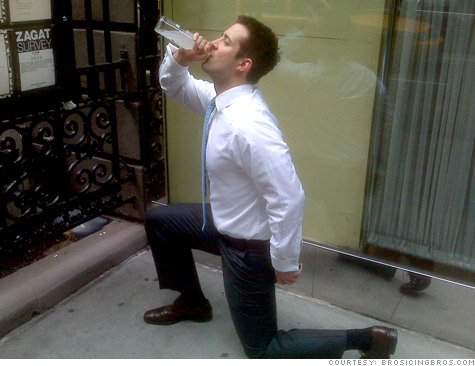
That's what "bros" across the land are hearing upon being forced to drink a Smirnoff Ice in one of the most bizarre real-life Internet meme strikes since Rick Astley Rick-Rolled the Thanksgiving Day Parade.

The premise is simple. Basically, a bro can present a Smirnoff Ice to one of his bros at any time in any setting, and the recipient must get on one knee and chug the beverage. According to the official web authority on the matter, brosicingbros.com, "you cannot refuse an Ice. If you refuse to drink the Ice, you are instantly excommunicated and shunned..."

The social game, according to Fortune (yes, they actually did a story on this) started on college campuses in South Carolina and has since spread throughout the country to tech corporations, hedge funds, and investment banks. It certainly seems that you ain't cool unless you ice your bros.

The key to "winning" the game, although nobody actually can win because the game never ends, you can only Ice or be Iced, is hiding Ices in places a bro would never think to come prepared. If you have an Ice on you, you may block an attack and force the Icer to drink themselves. If the Ice is left in an obscure place, the recipient bro almost certainly will be caught off guard and be forced to drink it.

The obvious assumption to make is that this started as some guerilla marketing campaign by Smirnoff and or Diageo, the UK company that owns the brand. After all, it is every product's dream to have some grassroots movement started by a target that has traditionally ignored or avoided your product.

Alas, according to the company, this in not the case. A company spokeswoman claims:
"The icing phenomenon is consumer generated ... Some people think it's fun. Diageo never wants underage icing."

The casual use of the term "icing" is very humorous to me, it says that either she's lying (almost certainly not the case) or that they've received countless inquiries as to their role in the fad (most likely).

Bros Stoning Bros?

Here, I have to digress for a moment. I've always had trouble believing that alcohol companies do not support underage drinking (or "icing" in this case). It's comparable, in my mind, to saying that tobacco companies have never (subliminally or otherwise) targeted children. We know that these companies aren't ALLOWED to target underage consumers (or else Lesley Fair and the FTC will behead them), that doesn't mean that they don't do so, even unintentionally.

My favorite example (and I've ranted about this before) is Keystone Light. Anyone that's ever set foot on an American college campus has probably had an encounter with Stones. Known more so for it's dirt-cheap price than its purported "Always Smooth" taste, Keystone is a staple amongst collegiate (read: underage) binge drinkers.

I have a hard time believing that MillerCoors, the parent company of the Keystone brand, is unaware that a majority of their business is directly related to underage consumers. If consumers were truly concerned with the "smooth" taste of their brew, chances are they wouldn't head to the back of the convenience store cooler for a 30 rack of Stones. Despite this, Saatchi and Saatchi is renewing the "smooth" USP with a series of commercials featuring the Always Smooth Keith Stone:


Cleverness of the spot notwithstanding, I think the brand would be much better served promoting its' low price than it's (dare I say) smooth taste. Advertising, especially creative advertising, can cure a lot of ills, but you need to get the USP right. Is it wrong to advertise to a target which can not legally purchase your product? Probably. But is it bad for business? Usually not.

Back to my original thought: do I believe that Smirnoff is not behind the Bros Icing Bros phenomenon? Yes, I suppose I do. While it will certainly help boost sales in the short term (despite some evidence to the contrary), it's just too silly (read: genius) of an idea to have been conceived by marketing execs. At least Smirnoff isn't advertising the wrong message or to the wrong people, like Keystone (or my other alcoholic bugaboo, Mike's Hard) does.


Tuesday, April 27, 2010

Using the man as the spokesman: CEOs in advertising

Hey folks, long time no blog.

I've been driven to write after seeing the following spot for GM several times in the last couple days:


In it Ed Whitacre, CEO of General Motors, assures us that GM is back on its' feet, having repaid the government its bailout loan money with interest well in advance. I have to think that it's a great idea to use a "don't worry" campaign, regardless of how fresh Whitacre's news actually is, because it's still prime time to pounce on Toyota and try to win one for the domestic automakers.

Ironically in what I assume is unrelated news, GM dropped Chevrolet's ad agency this week. It's significant because Campbell-Ewald is the premier agency in Detroit (or at least the only one I could name there based on my rudimentary knowledge with no further research). Literally every Chevy ad you've seen ("Like a Rock," "An American Revolution," et all) has been the work of C-E.

But all that is neither here nor there.

The Whitacre spot reminded me of another CEO speaking on behalf of his company in TV spots, and maybe it did for you too. Remember Sprint's Dan Hesse?


These ads, ranging back to 2008, never did it for me. For one, they're pretty awful. Advertisers use spokesmen because people pay attention to celebrities (or so research somewhere suggests). When your spokesman is your smug new CEO, people have no reason to put down the Cheetos and listen (or even keep it on the same channel).

Secondly, all I ever took away from these ads was who the CEO was. Maybe it's because the GM spot is still fresh, but it seems a lot more respectable because it seems like a special message. Hesse was barking at me about the wireless revolution for more than a year.

I decided to look into this, and see if there was any way GM could have been influenced by Sprint in tossing their Chief Executive into the advertising. I didn't have to look far.

Turns out, Hesse and Whitacre are both former CEOs of AT&T, Hesse from 1997-2000, and Whitacre from 2005-2007. They were contemporaries in the wireless business for 20 years.


The executive sphere has certainly always been viewed as an Old Boys' Club of sorts, guys bounce from corporation to corporation and bring each other along regardless of industry knowledge. The last thing GM should want to do is remind people of that: it doesn't make people want to buy your products when they consider that you're making $60 million a year in a job that your old connections got you.

So here's my advice for General Motors and Mr. Whitacre: quit while you're ahead. You have a good thing going, with the worst of the economic crisis behind you. This advertising message is cute and I believe justified, but you toe a fine line when you personify the company with the CEO. Don't let Ed follow in Dan's footsteps and become just another commercial talking head, or worse, just another reviled, smug chief executive.

Wednesday, February 10, 2010

Why USA Today Ad Meter Sucks

The best commercials of the Super Bowl, according to respondents using USA Today's Ad Meter, were as follows:

1. Mars’ Snickers — Guy plays football like Betty White
2. Doritos — Dog puts shock collar on owner
3. Bud Light — Man builds house out of beer cans
4. Budweiser — Fences don’t come in between friends
5. Coca-Cola — African sleepwalker finally gets Coke


The problems with the system are several:

A) The winning commercials all ran during the first quarter, if not the first commercial break. People are expecting funny and will choke on their Doritos laughing at the first amusing thing that happens in a commercial because they are waiting with baited breath for Betty White to get trucked. By the time a lot of the best (in my opinion) commercials ran (like Google's, which many many people thought was the best), people were already bored and were just comparing every spot to the last silly Bud Light ad they saw.

B) The "best" ads reward humor in the opening of the spots, because they'll score highly at the beginning, whereas a good ad does not necessarily need to be funny in the first 5 seconds to be successful. Betty White getting tackled probably got the Snickers spot scoring 10s on the Ad Meter right away, whereas ads like Google's took some time to develop and only would have scored highly at the end (and by people who paid attention).

C) The ads deemed the "best" just means that a room of 250 people thought they were the most entertaining. Good ads aren't always the most entertaining - David Ogilvy started his agency around the idea that the primary purpose of ads was to sell products (or ideas). While branding and entertainment is great, it needs to work toward the purpose of generating sales, which is how the success of advertising is actually measured, whether USA Today likes it or not.

Quite frankly, while I did chuckle at the Bud Light house and I thought it was a decent piece of advertising, it doesn't compel me to buy Bud Light, and therefore I don't think it's among the best ads on the industry's biggest stage.

Wednesday, October 28, 2009

Time to change majors...

...at least according to Livingston Miller in AdAge this week.

Miller claims that students aspiring to pursue a career in advertising would be better served by a major and subsequent bachelor's degree in any of the the "precious" subjects of science, history, art, literature, language and math. These are the degrees that will develop my brain, Miller says, whereas advertising is wasting my time.

Personally, I was upset upon finding out that I couldn't take more classes in advertising and have them count for credit. I am genuinely interested in this industry, and plan to enter this workforce right after I graduate from undergrad study. It is an insult and an outrage to have Mr. Miller say that he would assume someone with a Russian History major that was competing with me for a job would be "significantly brighter" than I am.

I responded to Miller's article in the only way I know how, with two heaping scoops of sarcasm:

Dr. Livingston, I presume? Or should I say, deckhand-turned-ad man Livingston, I presume.

Allow me to thank you for helping me to make up my mind and switch my major to Russian History! I had been looking for a really compelling reason to stimulate my mind with the lives of Lenin, Dostoevsky, and Gorbachev.

Of course I want to work in the advertising industry, but why bother learning things related to that? I have a whole career to bumble around at no name agencies like Seiter and Miller and learn those silly details. I'll be so much more valuable to an employer with my understanding of Marxism than any candidates who learned lame things like media planning!

After all, advertising schools certainly don't teach any of the key skills that help "Media people...know when the best deal is on the table" or that help "Creative people who ignite consumer interest with the right phrase or image." These things can't be learned...except this begs me to ask why you include Math and Art/Design in your ideal curriculum for aspiring ad people, since these are the skills they would also glean from an advertising major.

You forgot the best point of all: with a Bachelors' or Masters' in Advertising, I'll only be qualified to get an interview at almost any agency, and my carefully honed skills can help me get a job. A Russian History major, on the other hand, also has the backup plan of working as a tour guide in St. Peter's Square.


I encourage you if you are a part of this industry or just support my cause, to read Miller's article and give him a piece of your mind as well. If anything, it'll show future readers that Miller's is not the agency they want to work for and it may also show Miller that perhaps he should consider something other than the mastery of the life of Ivan the Terrible when evaluating possible new hires.

Tuesday, October 6, 2009

The FTC won't let me be

Last week I had the chance to attend a seminar entitled "Is This Ad Legal?" given by Lesley Fair, an attorney for the Federal Trade Commission. The gist of her message was, "if you see me again, you're probably in trouble," meaning we'd have screwed up by producing an ad deemed to be "unfair."

It would seem like someone like Fair (a most apros pos name, given her position) would be the enemy, but alas, she doesn't need to be. There is beauty in truth when it comes to advertising. In an industry consistently ranked near the bottom in the perceived honesty of its practitioners, there is indeed value in the truth. If I'm trying to create a successful long term campaign for anything, there is no advantage to being dishonest, I'll only feel the wrath of my customers and my competitors. As long as it's a fair game, I'm convinced I'm going to win.

Fair seemed to be all over a bunch of famous or formerly famous brands which had stretched the truth or otherwise did it injustice through omission. Why then, are there so many unfair advertisements in the media? Pretty much any ad on the web comes to mind, but how about the case of US fidelis:


This auto insurance claims to be better than the warranty on your car, and it is if by better they mean a much much bigger rip off. I looked into this after seeing the commercial featuring Rusty Wallace on ESPN over the summer. It disgusts me that any celebrity sponsor can jump onto an illegitimate company like this one (then again, you already know how I feel about celebrity endorsement in general).

Another more famous example of ads that shouldn't be allowed to exist:


A lot of people say they like these ads. The video even has a 5 rating and more than 500,000 views on YouTube. The ads are, however, misleading. Of course the site is not free. Unless an ad is clearly a public service announcement, you can probably expect that it is trying to solicit money from you. Not only is it not free, but most "customers" don't know this until their credit card is billed monthly for the chance to receive their "free" credit reports. The ad is even dishonest in it's portrayal of the characters: the lead singer of the freecreditreport.com band is Eric Violette, a French-Canadian actor who does not speak English. That bears repeating. This guy only speaks French. He doesn't even sing the super catchy songs.

Ms. Fair showed us the FTC's rendition of these commercials, theirs for AnnualCreditReport.com, the site that actually allows you to see your credit reports three times per year for free:


Beauty in truth? Yes. Good use of taxpayer money? Maybe.

Thursday, September 17, 2009

Why stay on strategy when you can have a celebrity spokesperson?

A fairly recent ad for Gillette body wash annoys me in a few ways, and I'll have to ask forgiveness from the consumer product advertising gods if I offend the mighty Procter & Gamble here.


In the first 13 seconds of this :30 spot, this appears like it could be an ad for Tiger Woods brand clothes, Nike, Gatorade, Tiger Woods PGA Tour 10, the PGA Tour, or any of the countless brands the sponsorship magnet represents. It is actually for Gillette.

I am a big fan of humor in ads, especially in television. I am not, however, a supporter of the failure to quickly introduce the brand, or the ever so popular meaningless endorsement. This commercial does have some decent jokes ("He can see us"), but neither the humor nor the celebrity endorsement do anything for me in making me want to buy this stuff. The only fact about the product (3x the moisturizing something-or-other) that makes it mean anything is almost hidden away at the :23 mark of the commercial.

Tiger signed with Gillette shortly after it was acquired by P&G a few years ago in a deal suspected to be worth anywhere from 10 to 20 million dollars over 5 years. P&G is now using that windfall to finance the watering down of the Gillette brand. A book I recently read, The Origin of Brands by Al Ries, would point out that Gillette entering the body wash market is a signal of convergence, a surefire way to commit brand suicide and finance your own funeral. They are essentially paying up to $20 million to confuse people as to what Gillette is.

Unfortunately, the other problem with this ad is that people love it. Yes it's funny, and yes Tiger Woods is the man, and yes daddy can show his kids the funny commercial he made at work, but nobody is going to rush out and buy Gillette body wash because of it.


Recent comments on this video on YouTube include:

"Omg I am laughing so hard!"
"hahaha I love the way he says check "
"tiger rules"

The funny thing about advertising is that you can get all the pats on the back, handshakes and giggles in the world when the ad runs, but nobody's giving you that raise until the sales figures come in. Tiger Woods is not marching into the BBDO office to hand YOU a giant check.

Perhaps the men behind this one could have started with a campaign and message along the lines of: "We are Gillette, we have body wash now. It cleans better than other body washes." It would beat the current copy: "Prepare your skin, with Gillette's new line of hydrating body wash." Ads like this one make me think that there are copywriters and creative directors out there who, while entertaining, need to get the Lennie Small treatment in this industry.

Yes, that was an Of Mice and Men reference. Deal with it.

Monday, August 31, 2009

Ready to be new again

And thus another semester is afoot. It seems like just yesterday I was scrambling to finish an 8-page final paper on Greco-Roman religion in a harrowing effort to get a B in a class on said subject.

Now I find myself an actual upperclassman. With half of college over with, I probably should know approximately where I'm going in life. That's just where I'm at: an approximate goal. I know I want to be involved in this industry. That's about it.

Our school has two "tracks" for advertising majors: management and creative. Either side will tell you that management people are the ones that interact with clients, make business decisions, wear suits and carry briefcases. Creatives wear jeans and loaf in bean bag chairs. Only the inflection in their respective voices changes when summarizing their own track.


I'm not sure which route I want to take. I had originally thought management because I do like to analyze and study advertising and follow the business moving and shaking. I also thought I wasn't creative enough for the opposite to be my profession. I have had second thoughts about that since, having been told that my creative work is passable. While not a Photoshop "wizard" as my Portfolio professor would say, I think I'm ok at conceptualizing ideas in ads.

This confusion is why I opted to take two completely different advertising courses this semester: ADV 401; Portfolio One and ADV 507; Advertising Media.

I had 401 today, and have come to find out that now is when the legendary competition in the S.I. Newhouse School of Public Communications really begins. For every "project," only one student in the class will receive the "agency recommendation" and a perfect grade, everyone else can do no better than a 90 ("presented to client"), or otherwise can score an 85 or lower.

I had just began to get to know most of the people in my major, and now I have to compete with them? Also, apparently, we'll be teamed up at various points and try to "Beat the Clock" with ad ideas in less than a class period. And who said class couldn't simulate the real world? I'm excited about the opportunities, but a little worried about the workload, especially considering I don't know what to expect from 507, a class on the opposite end of the spectrum and not to mention a graduate level course. Yikes.

First assignments from 401: Review the best ads of the year from '85, '95, or 2005 and pick a favorite, and choose the one campaign you can remember that was most effected you. I'll report back when I make my choices.

Fall semester 2009: here goes nothin'

Wednesday, August 12, 2009

An Ohio newspaper explains how Dubya was elected twice

As one can tell by the title and usual subject matter of this blog, I don’t normally comment on the news industries. What I found this past weekend however had to be posted somewhere.

Back story:

Driving back to Buffalo from the Pro Football Hall of Fame festivities in Canton, Ohio, we hit a rest stop in what I assumed was the lovely town of Ashtabula, near the PA-OH border. I went in to grab a drink and an Ohio lottery ticket (I lost), and saw the town’s newspaper sitting on a rack. I bought it instantly (with quarters I borrowed to get to $1.25).

Pictured are the front and rear pages of section A.


If you live in an area that is urban at all, perhaps you have wondered how the backwoods redneck culture can even still exist. Perhaps you wonder how politicians like those who raise their hand to this question ever get elected. Nobody actually buys a confederate flag decal for their pickup truck, right?

Don’t we all have a lot to learn about our country?

I’ll limit myself on the social commentary and just go on to the highlights of the article, for those of you that don’t want to try to read it and want a good laugh:

Ashtabula resident Jesse Staut on the appeal of the Redneck Games: “This is the most exciting thing happening in Ashtabula County this weekend…we all get together and they share the beer and I drink it.”

The festival’s rules on kids: “Make them, don’t take them.”

The couple pictured on the back page, Brittany and James, actually just met on Friday. This is Sunday’s paper.

Aforementioned Brittany on her heritage: “I was raised as a redneck because all of my family members are from West Virginia” (A sounding endorsement, if ere I’ve heard one).

And of course, the listing of events:
- Mud Volleyball (pictured on the front page)
- Redneck Horseshoes (difference from regular horseshoes is not mentioned)
- Tug-of-war
- Belly Flop
- Wet T-shirt contest
- Daisy Duke shorts competition

I wish I were kidding, ya’ll. Also note, I broke my boycott of things using Comic Sans to buy this paper.

Loading image

Click anywhere to cancel

Image unavailable

Loading image

Click anywhere to cancel

Image unavailable

Thursday, June 25, 2009

Adding Lil' to your name only works if you're a rapper

New from the people who brought you Lil' Wayne, Lil' Kim, Lil' Jon and the Eastside Boys, and expensive bottled water comes...

Here's Lil' Fiji, straddled by regular Fiji and what I assume is marketed as Big Ol' Fiji

That's right folks! The same bottled water shipped in from a rain forest on the island of Fiji, drank by the President himself now comes in a smaller and even less economical package! Why drink outrageously expensive 16 oz bottles of water when you can drink 11.2 oz bottles?

I was taken aback when I saw the above package on the shelf at Target. Now understand, I'm beyond the fact that people actually pay for water. Getting people to buy bottled water at all is one of the great successes of advertising of the last decade; most people have come to accept the practice. My house is constantly stocked with bottled water. There's something to the idea of the cleanliness or the healthiness of drinking a Dasani (Coke's tap water) or a Poland Spring (Nestlé ground water).

It's different when you're talking Natural Artesian Water. A nine-pack of Lil' Fiji goes for $8.99. A dollar a bottle. A 28-pack of Poland Spring 20 oz bottles goes for $6.54. That's 9 cents per ounce versus 1.2 cents per ounce. I didn't look up the comparable size for cheap water because 11.2 isn't really a legitimate or appropriate size for anything.

Let's go on the assumption that bottled water actually is better for you in some way than tap water. Therefore, both Poland Spring and Fiji (Lil' or otherwise) must both offer benefits that tap water does not. Based on the pricing, can we then deduce that Fiji is eight times better for you than the leading bottled water brand? In short, no.

People are willing to pay for brand names; if they weren't, my industry wouldn't exist. Somebody must be willing to pay a dollar a bottle for Lil' Fiji; the brand has actually been around for three years. To some people, Lil' Fiji must be eight times cooler than Lil' Poland Springs, or Lil' water from the faucet. To you folks, I say: thank you.

Without the upper echelon tool kits that buy products like Lil' Fiji because it comes from 8000 miles away and Barack Obama drinks it, branding would be meaningless, and I'd be drifting aimlessly through the world. And probably be a philosphy major.

Thursday, June 18, 2009

In a world without advertising...


A cute little project from Mindrally, the site withoutadvertising.com allows users to fill in the blank. Literally, and that's all there is to it.

It's just a little bit of Web 2.1 fun, there's no moderation, so as soon as you post something, it appears on the site until bumped by new entries.

Unfortunately, the site just further renews my lack of faith in the human race. Some stellar responses (those that I assume are serious) include:

Without advertising,

"...everything will be the same"
"...everything would be awesome"
"...tv watching would be simpler"
"
...all we'd have is the internet"

and of course...

"...i would be in cuba"

uhhhh...

You can see my entry in the screenshot (the one in yellow). I'm sure magazines as we know them actually wouldn't exist at all. Same with newspapers, TV, etc. I really can't imagine a feasible world without advertising. People say it brings up the prices of a lot of commodities, but it also brings down prices of media and other things, and creates competition that is vital to the survival of the economy.

"TV watching" would not be simpler...you'd have 3 channels to pick from and you'd have to pay a few hundred dollars a month to see them. But, heaven forbid Joey Baggadonuts opens up his limited worldview to see that commercials are more than annoying breaks in Family Guy and The Real World.

I'm considering adding to the list:

"...people would have one less thing to not understand."
and
"...I'd have a boring major."

Tuesday, June 16, 2009

Comic Sans: Sans Purpose.

I’d like to think that as a student of advertising with some graphics experience, I have somewhat of an eye for design. And yet, I know a lot of my notions about visuals aren’t just from education. A lot of people can tell you something generally looks good (or especially, bad) without any sort of formal training. This then begs the question, why does Comic Sans exist?

Comic Sans has been a default Microsoft font since Windows 95. It was developed by Vincent Connare, an early Microsoft programmer/designer who was distraught when he saw a comic strip that used Times New Roman for the dialogue. He sought out to create a more fun, cartoony font. The monster he created became arguably the worst typeface for 99% of type, projects, and signage.

“What’s so bad about it,” you might ask? “I think it’s whimsical!”

Try reading an entire paragraph, or an entire page in Comic Sans. Even better, go for the all popular ALL CAPS COMIC SANS. The strokes are too fat, the letters and the spacing are uneven, and extensive exposure to this immature little font has been known to cause retinal bleeding in adults and pose a threat of birth defects to pregnant women.

If you want your restaurant/auto repair shop/day care to look like it’s owned by a six year old, buy some big neon Comic Sans signage.


Tom Fauls, associate professor of advertising at BU, has said:

“Good typography should be like a wonderful clear crystal goblet that holds wine, much better than a golden goblet that has jewels on the outside because the point of the crystal goblet is that you can see the wine that’s inside, you can appreciate the colors…”

Going on that metaphor, if good typography is a crystal chalice, Comic Sans is a lime green tippy cup you find under the couch when you move your furniture, when you haven’t had young children in 17 years, that still has a little chocolate milk in it from its last use.

Just about nothing looks appropriate in Comic Sans. Many people who would claim to having little to no design experience could spot the problems here:


Needless to say, you can’t be taken seriously if you choose to use this font for just about anything. That is why I’m calling for a personal boycott on any business caught patronizing Mr. Connare’s wonderfont. If you don’t show the creativity or effort to pick out a font that isn’t Comic Sans, I’m no longer going to trust you with my business.

I have been beaten to this cause by the website bancomicsans.com The creators took up their cause in 2002 to get the font removed from the defaults in Microsoft programs, and have a massive online petition. As much as I fear that their signatures will fall on deaf ears (as they have thus far), I only hope to spread their message in the hopes that people can gain a tiny little bit of an eye for design and some self respect and stop using Comic Sans.

Or else...


Please.